Geekfly Super 16
Super 16 Purchase – Super 16
A Little Technical Stuff:
Audio and Hardware Specs
- Driver Configuration 16 drivers per ear: 12 BA + 2 Bone Conduction + 1 Planar + 1 Dynamic
Amplifier
- Architecture Digital Amp + Class AB Analog Amp (switchable)
- Hardware Tuning 32 combinations (Bass / Mid / Treble / Ultra-high, independently adjustable)
- Crossover 4-channel, 4-way design
- Bluetooth Bluetooth 6.0
- Codec Support LDAC, LC3, aptX, AAC, SBC
- Battery Life 12 hours (earbuds) + 36 hours (charging case)
- Chipset Qualcomm QCC3091
- Onboard Memory 64MB
- Battery Capacity 85mAh (per earbud)
- Antenna Anti-interference 2.0
- Call Quality HD voice, upgraded mic array
-MSRP: Super 16 USD $2499.00
Greetings from the Audio Rabbit Hole.
Back at the writing board with another wireless offering. This one is special for a couple of reasons. First is the price, second is its ability to push the limits of wireless sound. The Geekfly Super 16 takes us down an entirely different path than the Vitas Pro I reviewed previously. I even went beyond my budget to give these a whirl.
I originally set a limit of around $400 to $500 for wireless earbuds. I set limits for myself in the wireless realm, compared to the wired realm, because more factors are involved beyond the source and the earbuds themselves. In the wired world, the source and IEM or headphone are the two key components.
Of course, if you’re a cable believer, the cable becomes another tweak, then there’s the DAC, amp, and so on.
The difference is that those are choices we make. We decide on the source, the DAC, the amp, the cable, and ultimately how far down the rabbit hole we want to go. With wireless gear, many of the variables are already baked into the product.
Your phone, codec support, app implementation, and listening environment can all influence the experience. Two people listening to the same earbuds can have very different results.
That’s why spending flagship-level money on wireless gear has always been a tougher proposition for me than doing the same in the wired space.
That brings us to the Geekfly Super 16, a $2,499 true wireless bud that makes my original $500 spending limit look more like a polite suggestion than an actual rule.
On paper, spending this kind of money on something with batteries feels like a terrible life decision. Then you hit play, and suddenly the little voice of financial responsibility gets a lot quieter. More importantly, the Super 16 is an absolute banger on the sound front.
A Little Marketing Hype, straight from their site, no edits:
16-Driver Hybrid System
- 12 Balanced Armatures: 4 mid + 4 high + 4 ultra-high
- 2 Piezoelectric Bone Conduction Drivers: high/ultra-high detail
- 8mm Planar Driver: high-frequency detail
- 8mm Dual-Magnetic Dynamic Driver: silicone + bio-diaphragm, handles bass
All drivers are custom-developed by GEEKFLY, delivering class-leading performance across all 16 units.
Dual-Amplifier Architecture
Class D Digital – Power-efficient, up to 12 hours playback; refined and balanced; amp delivers detailed mids and highs, high resolution
Class AB – Fuller body, stronger bass dynamics, warm vocals, smooth treble
Analog Amp – higher density across all bands
GEEK Audio Tuning Platform
- Full-band hardware crossover tuning
- Independent adjustment for Bass, Midrange, Treble, and Ultra-high
- 32 hardware tuning presets — each tuned and optimized by the GEEK Audio team
Wireless Performance
- Bluetooth 6.0 with HD wireless decoding
- HD voice calls
- 85mAh battery
- 64MB onboard memory
- Anti-interference 2.0 antenna
“Wireless that rivals wired.”
“32 ways to hear it.”
32 hardware tuning combinations — true personalization.
“Two amps, two personalities.”
Digital for clarity and efficiency; Analog for warmth and body.
“16 drivers. No compromises.”
A true flagship for the most demanding listeners.


WHAT’S IN THE BOX:
- Geekfly Super 16 TWS Earbuds
- Charging Case
- USB‑C Charging Cable
- Silicone Eartips (S/M/L)
- Quick Start Guide
- Warranty Card

Unboxing and Accessories:
The unboxing experience is next level. Then again, for a $2,499 purchase, it probably should be. If I open the box and find a ziplock bag and some bubble wrap, somebody is getting an angry email. I remember making the same comment about the Vitas Pro.
Both the Vitas Pro and Super 16 deliver the kind of presentation that reminds you exactly where your money went… at least for the first five minutes before the audiophile side of your brain starts calculating cost per milliwatt and wondering if you’ve completely lost your mind. The Vitas Pro impressed me, and somehow the Super 16 raises the bar even further.
I’ll let the pictures take over from here:


Build, Design and Features:
The Super 16 looks more like someone took a high-end wired IEM and forgot to attach the cable. These aren’t sleek, minimalist earbuds designed to disappear. They are 16-driver behemoths, and Geekfly isn’t trying to hide it.
The fit will be a challenge for some listeners, though fit is one of the most subjective aspects of this hobby. I affectionately call them my Frankenstein bolts. They protrude noticeably from my ears and make absolutely no attempt to hide their 16-driver ambitions. Subtle they are not.
Despite their size, I don’t find them uncomfortable. I’ve worn them through several weight-training sessions without issue. Cardio is another story. If I were jogging with these, I suspect I’d spend half the workout pushing them back into place and the other half watching $2,499 worth of audio equipment bounce across the pavement like a tiny, very expensive game of fetch.
I have some comparison photos of the Super 16 next to the Vitas Pro so you can get a better idea of the size difference. I’ve always felt the Vitas Pro was on the larger side, albeit a very comfortable one. After spending time with the Super 16, the Vitas Pro suddenly seems downright compact.


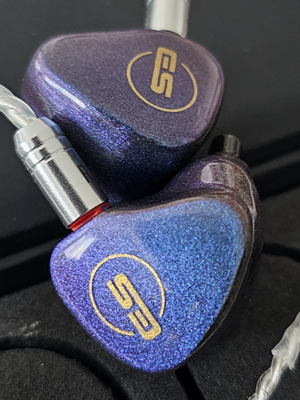
Geekfly offers four faceplate options, and unsurprisingly I chose the blue one. The pattern reminds me of ocean tides washing onto a shoreline. Or maybe a nebula. Or perhaps the emotional aftermath of spending $2,499 on true wireless earbuds.

Whatever it’s supposed to represent, it looks fantastic. I care more about sound than aesthetics, but Geekfly did a great job here.
The resin shell looks very well executed. I can’t find any obvious seams between the faceplate and the shell, and the overall construction feels solid and premium. That said, it is still a resin shell, so keep that in mind if you’re less than gentle with your gear. Resin offers excellent acoustic and aesthetic properties, but it isn’t known for shrugging off repeated drops onto hard surfaces.
If you’re prone to launching your IEMs across the room or onto concrete, that’s more of a user issue than a manufacturer issue. Know what you’re buying and treat it accordingly.
My only aesthetic complaint is that the charging case and earbuds seem to have been introduced through a mutual friend and are still getting to know each other.
The black-and-gold luxury case looks like it belongs at a high-end jewelry store, while the blue-and-purple faceplates look ready for an electronic music festival. Both are attractive, but I’m not entirely convinced they’re speaking the same design language. A matching case option would have tied the whole package together nicely.
 The nozzle is noticeably broader at the base and longer than the one found on the Vitas Pro, which helps explain why the fit can be a bit more awkward for some listeners. I’ll include a comparison photo below so you can see the difference for yourself.

As for ear tips, I appreciate Geekfly’s generous selection. That said, I’m an unapologetic ear tip hoarder and almost always end up digging into my own collection. For the Vitas Pro, I settled on the SpinFit Omni. With the Super 16, the Divinus Velvet proved to be the better match, specifically the standard version rather than the wide-bore model.
The Super 16 is unapologetically about sound quality, not features. It’s difficult to argue otherwise, and I don’t think Geekfly gets a free pass simply because they’re relatively new and still finding their footing in the true wireless space.
Just like the Vitas Pro, you’re not getting active noise cancellation, transparency mode, multipoint connectivity, polished app support, wear detection, strong call performance, or deeply customizable controls.
If your buying decision is driven by features, convenience, and ecosystem integration, countless options at a fraction of the price will outdo the Super 16. Geekfly clearly prioritized sound quality over features. Whether that tradeoff makes sense depends entirely on what you value most as a listener.
Call quality is serviceable, but honestly, nobody is spending $2,499 on a pair of earbuds because they’re looking for the ultimate conference-call experience. Indoors, I had no complaints. Voices came through clearly, and callers reported I sounded natural.
Outdoors is where things fall short. Environmental sounds remain quite present, and while my voice was still understandable during normal walks, traffic noise, wind, and general ambient sounds frequently made their presence known. The microphones get by, but earbuds costing a fraction of the price handle calls more effectively.
There is no ANC, and at this price point that omission will be a non-starter for many buyers. Passive isolation is quite good with the right tips, but passive isolation and active noise cancellation are not the same thing. If ANC is high on your priority list, the Super 16 is pointing in a completely different direction.
There is no wear detection either. Pull an earbud out and your music keeps playing until you manually pause it or return it to the case. Some will care, some won’t, but it’s still a notable omission.
The Super 16 also appears to lack any advertised IP rating. Given the price, I certainly wasn’t interested in destructive testing, so I’ll advise caution around rain, excessive sweat, and other wet environments.
Battery life has been good throughout my use, and I never worried about making it through a day of listening. I would still recommend consulting Geekfly’s published figures for your preferred codec and listening volume, as battery performance can vary significantly depending on usage.
Connectivity was stable throughout my review period, and codec support includes the formats audiophiles actually care about. More importantly, the Super 16 supports external Bluetooth transmitters and dongles, allowing enthusiasts to maximize codec availability and tailor the source chain to their preferences.
And now we finally arrive at the reason anyone is considering a $2,499 true wireless earbud in the first place. The feature section may have landed a few body shots, but the Super 16 wasn’t built to win on the spec sheet. It was built to answer a far more ridiculous question:
How close can a true wireless earbud get to a serious wired IEM?
And that’s where things get interesting
Super 16 vs. Vitas Pro


Review Setup:
My review was written using the Google Pixel 11 Plus, Fiio M27 Ti. For my sample music, I explored a range of formats, including 320 kbps, FLAC, and 24-bit audio, as well as streaming services such as Spotify Lossless and Qobuz Hi-Res.
Geekfly App
The Geekfly app is available for both iOS and Android users. Since my Vitas Pro review, Geekfly has updated the app to version 1.1.9, and I have to give them a huge thumbs up. The new user interface is cleaner, more intuitive, and significantly less flaky.
Interestingly, the latest version is currently hosted outside of the Google Play Store. I’ve included a link to Geekfly 1.1.9, and while the download process can test your patience, it does work. Just stick with it. Geekfly App 1.1.9


The app includes many of the same features as the Vitas Pro, but the Super 16 takes things a few steps further when it comes to sound customization. This is where the additional amplifier and crossover options come into play.
Changes to the EQ, amplifier, and crossover settings are immediately audible and allow users to meaningfully tailor the presentation to their preferences.
Excellent job, Geekfly. The app feels like a useful part of the ownership experience rather than a feature you’ll use once and forget.

Moving on to the sound section….
Those of us who have been around the hobby long enough remember when manufacturers thought the solution to every problem was to keep cramming more drivers into an IEM. More drivers, more better. The Super 16 certainly doesn’t suffer from a lack of drivers, but unlike some of those creations from years past, the implementation here is thoughtful and well executed.
If you asked me to sum up the Super 16 in a single sentence, I’d say it is one of the most complete sounding true wireless earbuds I’ve heard.
The app plays a significant role in the Super 16 experience. Unlike most of my wired gear, I spent considerable time experimenting with the EQ, amplifier, and crossover settings. All sound impressions in this review are based on my preferred configuration rather than the default tuning.
The bass has a dense, authoritative presence. Whether your attention is drawn more toward the sub-bass or mid-bass will likely depend on your music and preferred settings, but either way, bass is one of the first things you’ll notice about the Super 16.
Interestingly, its presence stands out even more than its quality on first listen. That’s not a criticism of the quality. Quite the opposite. The bass is exceptionally well controlled, textured, and technically impressive. Its sheer physicality and weight demand your attention before you appreciate how refined it is.
The Super 16 isn’t shy about delivering low-end energy, but it also avoids the trap of becoming a one-note bass cannon. Genuine substance backs up the quantity, giving the presentation both impact and sophistication.
On Boney James’ Things Are Looking Up, the bass line’s articulation is incredible. Yes, it’s smooth jazz and I’m talking about bass. Somewhere an audiophile is waiting for me to discuss saxophone timbre.
What impressed me here wasn’t the quantity of bass, but the quality. The bass line is rich, textured, and incredibly easy to follow throughout the track.
The Super 16 presents it with enough weight to anchor the music while maintaining the kind of articulation that lets you appreciate the musician rather than simply the frequency response. That’s a far trickier feat than just adding more bass.
The midrange easily passes my Norah Jones *”Don’t Know Why”* upper-midrange test. If an IEM is overly aggressive in the upper mids, that track will usually let me know in a hurry. The Super 16 never crosses into harshness with my preferred settings.
What stood out most was the articulation and sense of space. Instruments and vocals have room to breathe, creating a presentation that feels open and uncongested. Female vocals, in particular, are exceptionally detailed and well-defined, but they stop short of becoming fatiguing.
That’s not an easy balance to strike. Too often manufacturers chase detail by pushing the upper mids forward, only to end up with a sound that impresses for fifteen minutes and exhausts for two hours. The Super 16 delivers detail without the punishment.
The treble extends well without sounding sharp or artificially enhanced. There is plenty of detail, air, and sparkle, but it remains controlled and natural. Cymbals have realistic decay, microdetails are easy to pick out, and the Super 16 never feels like it’s forcing detail down your throat. Even during longer listening sessions, I found the treble engaging rather than fatiguing.

To summarize the sound:
The Super 16 sounds spectacular, but more importantly, it can be whatever you want it to be. The hardware is there, and the software lets you tailor the presentation to your liking.
The soundstage has impressive height and depth, creating an immersive and layered presentation. The biggest compliment I can give Geekfly is that, despite all the DSP tricks available, the Super 16 never sounds artificial or overly processed. The tuning options enhance the experience without taking away from the natural character of the drivers.
You might want to own the Super 16 if:
+ You want a true wireless earphone that prioritizes sound quality over everything else. The Super 16 is built for listeners, not feature hunters.
+ You enjoy a rich, highly capable presentation with powerful bass, spacious mids, extended treble, and impressive stage depth. It sounds refined without sounding clinical.
+ You like tailoring your sound. The EQ, amplifier settings, and crossover adjustments make meaningful changes and allow the Super 16 to adapt to your preferences.
+ You don’t need ANC, transparency mode, multipoint, wear detection, or class-leading call quality to enjoy your music. Geekfly spent its resources chasing sound quality instead.
+ You’ve accepted that this hobby occasionally involves questionable financial decisions and are willing to spend $2,499 to see how far true wireless audio can be pushed.
In Closing
The Super 16 is not a flawless true wireless package, and at $2,499 it shouldn’t be given a free pass. The lack of ANC, transparency mode, multipoint, wear detection, and other modern conveniences are legitimate criticisms.
But Geekfly clearly wasn’t chasing the feature crown. The Super 16 was built around sound quality, tuning flexibility, and pushing true wireless audio as far as possible. The result is one of the most capable sound-first true wireless earphones I’ve heard.
The fit won’t be for everyone, and the price certainly isn’t for the faint of heart. If your priority is extracting the best possible sound from a true wireless earphone rather than checking boxes on a feature list, the Super 16 makes a compelling argument.
It has flaws. It has omissions. It occasionally feels like the feature department took a long lunch. But when the music starts, the Super 16 reminds you why we fell down this rabbit hole in the first place.
Related Posts