Fiio Snowsky Oak Nano
Audio46 Main Site – Audio46
Audio46 – Fiio Snowsky Oak Nano
A Little Technical Stuff:
- Driver: 13.8mm DLC beryllium-alloy dynamic driver
- Design: Universal-fit vented IEM
- Frequency Response: 10Hz–40kHz
- Impedance: 50Ω @ 1kHz
- Sensitivity: 112dB/mW @ 1kHz
- Shell Material: CNC-machined titanium alloy
- Connectors: flush 0.78mm 2-pin
- Cable: Cryogenically treated silver-plated monocrystalline copper
- Plugs: 3.5mm, 4.4mm, USB-C DAC/PEQ module
- Weight: ~8.9g per side
-MRSP: Universal fit $449.00
Greetings from the Audio Rabbit Hole, where logic comes in balanced, single-ended, and occasionally USB-C.
Special thanks to FiiO for the opportunity to review the FiiO Snowsky Oak Nano; I appreciate it.
I am not exactly sure where to start with this one, so let’s grab a flashlight, make poor financial decisions responsibly, and head a few steps down the Audio Rabbit Hole. The OAK Nano lands under FiiO’s Snowsky umbrella, which, in my mind, has usually been home to the more budget-minded side of the lineup. That is not a knock. Snowsky has always carried a slightly youthful, playful vibe to me, like it might show up to an audiophile meet with a backpack full of dongles, three spare adapters, and entirely too much confidence.
My first assumption was that the OAK Nano might be FiiO’s next flagship-style answer to the FD7. Then the pricing taps you on the shoulder and whispers, not so fast, spreadsheet cowboy. The FD7 launched around $600, while the OAK Nano arrives at $449. That may help explain the Snowsky placement. Another likely factor is the driver itself: the FD7 uses a pure beryllium driver, while the OAK Nano uses a beryllium-alloy dynamic driver. In other words, the rabbit hole has already forked, somebody forgot to label the tunnels, and we have not even reached the listening section yet.
Anyway, all of these assumptions and rabbit-trail questions are fun to kick around, especially if you enjoy turning driver materials into personality tests, but when it comes time to review the little titanium troublemaker sitting in front of me, they do not really change the job at hand.
So let’s begin this little titanium tumble down the Audio Rabbit Hole, shall we?
Translation: we are officially past the sensible portion of the hobby and approaching the part where nozzle rings, driver metallurgy, and price brackets all start acting like they deserve character development.
A Little Marketing Hype, straight from their site, no edits:


WHAT’S IN THE BOX:
Unboxing and Accessories
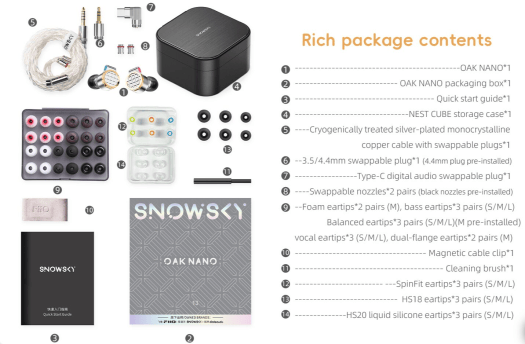
Usually, I give you a tidy little bullet list of what comes in the box. With the Oak Nano, that felt less like organization and more like trying to alphabetize a junk drawer during an earthquake, so photos are doing some of the heavy lifting here.
Unboxing the Snowsky Oak Nano, which I will call the Nano or Oak Nano from here on out, is genuinely impressive. This is one of those “everything but the kitchen sink” presentations, and for once that phrase does not feel like reviewer exaggeration. FiiO packed this thing like they were trying to make the accessories table look underdressed. At this price point, I have not seen many competitors touch this level of included extras.
It is the kind of box that makes you wonder if FiiO misunderstood “include accessories” as “prepare the listener for a small expedition.”


The outer sleeve shows off the Snowsky name and Oak Nano branding. Once the sleeve is removed, you get a black presentation box with upper and lower flaps sealed by a sticker. Peel that away, and the box opens with a magnetic flap that drops down as the top opens, because apparently a normal lid would have been too emotionally stable.
The whole flap-and-drawer routine feels like an audiophile escape room, except the prize is not freedom; it is realizing there are still more accessories underneath.


From there, the accessory parade begins. Inside, you get the Quick Start Guide, the hard storage case, and the Oak Nano IEMs themselves. The rest of the box uses slide-out drawers for the accessories. I will highlight the main items here, but the photos can handle the full inventory because I only have so much emotional bandwidth for tiny packaged objects.
At this point, the unboxing feels less like opening an IEM and more like FiiO dared the accessory department to keep adding things until the cardboard asked for a meeting with HR.

FiiO includes a cryogenically treated silver-plated copper cable with interchangeable terminations and a swappable connector system. You can choose between 3.5mm single-ended, 4.4mm balanced, and a USB-C module that integrates a DAC and eight-band parametric EQ through the FiiO app. The eight-strand cable is nicely built, has very little to no microphonics, and remains fairly flexible. The replaceable connector end has an arrow showing the insertion direction, but the cable side itself is not marked, so you need to check the female connector on the cable and line it up with the small notch.
The USB-C DAC/PEQ module is the moment the cable stops being a cable and starts asking if you have updated its firmware recently.
I lost count of the eartips, but there appear to be twenty-two pairs, including SpinFit, FiiO HS18 and HS20 premium tips, plus double-flange options.

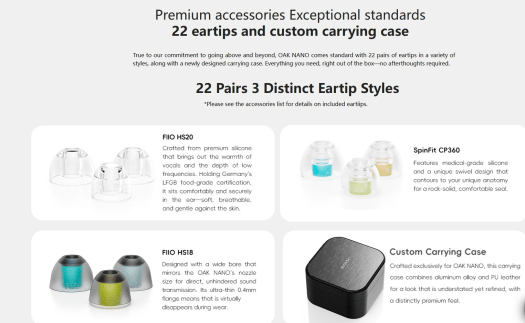
Twenty-two pairs of tips is not an accessory bundle; it is a silicon town hall meeting, and somehow your ears will still vote for the pair you already owned.
The hard storage case is not something I would realistically carry in a pocket, but it would be perfectly fine tossed into a backpack.

FiiO also includes a magnetic cable tie and a brush for cleaning the nozzles.
The nozzle brush is practical, but it also confirms we have reached the part of the hobby where maintaining tiny sound tunnels feels perfectly normal.
The last accessory I want to touch on is the included tuning nozzles. Two screw-in nozzle sets are included: the pre-installed set with the black ring and an alternate set with a red ring. I will cover the sonic differences later, but the tuning changes are easy to hear. Including swappable nozzles is a nice touch and gives the Nano some useful flexibility.

Two tuning nozzles mean two chances to tell yourself this is controlled testing, when, really, you are hunched over a desk, swapping tiny metal parts like an audiophile raccoon.
Build Quality and Fit:
Maybe one day I will stop adding the usual footnote to these sections, but today is not that day: build quality and fit are wildly subjective.
Fit commentary is where every reviewer becomes part audiophile, part ear-cartographer, and part person quietly wondering why their left and right ears apparently negotiated separate contracts.
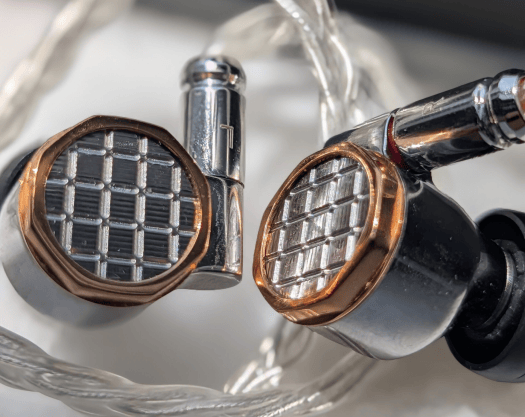
Once you see the Nano in person, the octagon faceplate, gold outline, and silver center make it clear that FiiO put real thought into the design. The shells are CNC-machined from titanium alloy, which is not exactly the lazy route through the manufacturing department. At this price, which is not cheap but still nowhere near summit-fi nonsense money, this level of material choice and machining effort stands out. Even with the metal housings, each shell remains fairly light at about 9.6 grams.

The Oak Nano has a polished, mirrored finish with no blemishes or seams that caused me any comfort concerns. These feel built to last, and I do not foresee obvious durability issues. Yes, the finish collects fingerprints as if it’s building a legal case against your hands, and yes, you could probably scratch or scuff it if you tried hard enough. Still, the design is striking. I had morning light hit the shells through my office window, and the little titanium show-offs made me smile.
One detail worth calling out is the nozzle threading. It is machined cleanly, and the nozzles screw in straight and easily without the roughness or burring that can make them feel crooked or sketchy.
The 2-pin connectors are color-coded red for right and blue for left. I counted four vent holes on the Nano: three near the 2-pin connector housing and one on the back of the shell near the nozzle.

Internally, the Nano uses a two-chamber structure. The front chamber directs sound toward the ear, while the rear chamber helps control airflow behind the driver. I will admit I did not go full lab-coat investigator on this one, so if you want the deep engineering rabbit hole, please feel free to crawl in first and leave a trail of breadcrumbs.
Those who read my reviews will not be surprised by this: based on the Nano’s styling and shell shape, I had to work a bit to get the right seal. You are probably thinking, subguy812, you have twenty-two pairs of included tips and still could not immediately find a seal? Correct. Welcome to my ears, the least standardized product category in audio. Even with all those options, I still went to my own tip box, partly because I like keeping the original packaging pristine and partly because I apparently enjoy making simple things weird. This is not really a tip problem, though; it is more about the form factor. I have had similar fit adventures with Dita and Meze IEMs, and I touched on it in the Meze Astru review.

Yes, I had twenty-two included tip options and still went to my own box. This is not hypocrisy; this is audiophile tradition wearing sweatpants and pretending it has a system.
I eventually settled on the Divinus Velvet tips and have not looked back. They gave me an excellent fit and sound quality. That said, the amount of time it took me to lock in a solid fit with this form factor was off the chain, which is reviewer-speak for “I spent too long rotating tiny objects in my ears and calling it evaluation.”
Review Setup:
I crafted the review using a few key sources: the Pixel 10 Pro, paired with an Astell & Kern HC5 dongle, and the Fiio M27 Ti DAP. For my sample music, I explored a range of formats, including 320 kbps, FLAC, and 24-bit audio, as well as streaming services like Tidal, Spotify Lossless, and Qobuz.

Moving on to the sound section….
I want to open the sound section with the tuning nozzles, because they ended up mattering more than I expected. The Nano includes two sets: the installed black-ring nozzles and the alternate red-ring nozzles. I honestly forgot about the red set at first, but once I installed them, I never went back. For the rest of this review, the red-ring nozzles are the ones in use.
The black nozzles had their audition. Then the red nozzles walked in with a calmer attitude, fewer sharp elbows, and the keys to my long-listening comfort zone.
Before getting into the meat of the review, the black nozzles deserve a quick mention. To my ears, they make the Nano sound more forward and open, with extra treble air and a snappier presentation. They also highlight the speed of the 13.8mm dynamic driver. Even though this is a single-driver IEM, the Nano never feels bogged down when a track gets busy. It stays quick, clean, and composed with either nozzle, but the black nozzles really show how agile this driver can be. So why switch? Because during longer sessions, the black nozzles can bring a bit too much treble sizzle and shout. They are exciting in short bursts, but I found the red nozzles smoother, more relaxed, and easier to live with.

With the red nozzles installed, I would describe the Oak Nano as a technical performer first. Its strengths are staging, separation, speed, and detail retrieval. It adjusts well to the information in a track and can pull out quiet background details without making the presentation feel forced. Transients are excellent, and upbeat smooth jazz from Four80East, Jazz Holdouts, or Boney James plays right into the Nano’s wheelhouse. The rock band, Close Enemies’ “More Than I Could Ever Need” also does a good job of showing how capable this IEM can be with rock.
The staging is open and easy to read, giving a clear sense of where the music is happening. The black nozzles create a slightly more precise and vivid space, but they are not really my cup of tea for longer listening. Even with the red nozzles, the Nano delivers some of the best staging I have heard from a single dynamic-driver IEM.
Drivability is a piece of cake. Every source I tried sounded excellent, and I heard no background hiss. The A&K HC5 dongle was an especially good pairing, adding a bit of smoothness without dulling the Nano’s technical strengths.

This time, I am leading with the Nano’s biggest strengths before breaking things down into bass, mids, and treble. I am impressed overall, but the headline here is not simply that the bass, midrange, or treble are good. The real story is that staging and technicalities are king.
In normal-person terms, the Nano is very good at making space. In Audio Rabbit Hole terms, congratulations: we are once again judging imaginary room dimensions inside our skulls.
The bass is controlled, punchy, and quick. Decay is short enough that notes do not linger or bleed into the lower mids, but the Nano still has enough presence to keep things from sounding thin. Think speed first. The bass quality is very good, with clear layering and enough sub-bass and rumble to satisfy without turning the Nano into a basshead IEM. It is polite enough to stay in its lane, but it is not absent or shy.
For the midrange, The Warning’s “Ego” is a good example. The vocals sit slightly behind the rest of the mix, but I hear that more as a production choice than a Nano problem. The Nano generally presents the track as it is mixed, with clean, clear, and detailed mids. The black nozzles push the mids a bit further forward and open up, while the red nozzles can slightly nudge vocals back. If there is a weaker area here, vocals would be it, though they are far from poor.
Treble has enough sparkle to keep jazz playlists lively, but with the red nozzles, I do not get the sizzle or fatigue that showed up with the black nozzles. Percussion, snares, and cymbals sound natural, with no obvious artificial edge or metallic weirdness photobombing the music.
In closing this sound section, the Oak Nano is more about technicalities than pure tonality. That is not a complaint; it is the main reason I came away impressed. FiiO has been around long enough that most hobbyists know the name, and the Nano shows just how far the company has pushed its single dynamic-driver designs.
So yes, the Oak Nano has entered the rabbit hole wearing shiny titanium shoes, carrying a drawer full of accessories, and politely reminding me that one well-executed dynamic driver can still cause reviewer brain static.
You might want to own this IEM if:
+ You want a single dynamic driver that behaves less like a simple one-driver design and more like it secretly brought a project manager for staging, speed, and separation.
+ You like an IEM that throws a wide, readable stage without making you reach for a whiteboard, a laser pointer, and an apology to your non-audio friends.
+ You prefer bass that punches quickly, cleans up after itself, and does not turn every track into a subwoofer audition at a car meet.
+ You are probably going to choose the red-ring nozzles, because they keep the Nano lively without letting the treble pull up a chair and start arguing with your forehead.
+ You want the full FiiO accessory spectacle: swappable plugs, USB-C DAC/PEQ tricks, tuning nozzles, a serious cable, and enough tips to make the box feel like it has a second career in logistics.

In Closing
Overall, the FiiO Snowsky Oak Nano feels like a very real reminder that a single dynamic driver can still show up with serious technical chops, a shiny titanium suit, and absolutely no interest in being written off as simple.
This is not the warmest, lushest, most romantic-sounding IEM in the drawer, and it is not trying to be. The Nano’s personality leans toward staging, speed, separation, and detail retrieval, which means it spends more time organizing the music than bathing it in candlelight.
The red-ring nozzles are where the Nano clicked for me. They keep the technical strengths intact while calming the upper energy enough for longer sessions. The black nozzles are fun if you want more bite, air, and immediacy, but for my listening, the red set made the Nano feel more complete and easier to live with.
Bass is quick, controlled, and clean rather than oversized; the mids are clear and detailed, and the treble has enough sparkle without becoming the tiny cymbal-shaped villain of the story when using the red nozzles. The stage is the real headline, though. For a single dynamic-driver IEM, the Nano throws a surprisingly open and readable space, which is exactly the kind of thing that makes audiophiles start using hand gestures to describe sounds no one else in the room can see.
The build and accessory package also help the Nano make its case. The titanium shells feel premium, the swappable terminations are genuinely useful, the USB-C DAC/PEQ module adds flexibility, and the included tips, nozzles, case, cable tie, and cleaning brush make the box feel like FiiO packed for a weekend trip through the Audio Rabbit Hole.
The fit may take some work depending on your ears, because apparently ear canals remain committed to being independent contractors, but once I found the right tips, the Oak Nano rewarded the effort.
If you want a technical, spacious, well-built single dynamic-driver IEM with flexible tuning and a delightfully excessive accessory kit, the Oak Nano is easy to recommend. It is a polished, capable little titanium troublemaker, and yes, it absolutely belongs down here in the Audio Rabbit Hole.
As always, these are my subjective thoughts based on my ears, my sources, my music, and my time with the Nano. This hobby is wildly subjective, and that is part of what makes it fun, frustrating, expensive, and occasionally ridiculous. Please read and watch other opinions before making a decision, because what locks in perfectly for one listener may send another person straight back to the tip drawer, the nozzle bag, or the nearest financial support group.